
Plane

PLANE WINDOW THREE

WINDOW 3 COMMUNITY SUPPORT TO LEARNING PROGRAMME IN NORTHWEST NIGERIA.
Partnership for learning for all in Nigeria

Window 3

Project Goal

MORE children and young people acquire skills to transition to productive life opportunities.  This project uses evidence-based approaches to increase community-based support for marginalized children, especially girls and children with disabilities, through building foundational competencies, fostering empowerment, strengthening protection systems, and supporting families to overcome barriers to quality inclusive education.
Outcome
More inclusive and  effective education systems deliver foundational skills: State and non-state providers enable better learning outcomes, including for marginalized groups.

Intermediate Outcomes:

Window 3

Donor

Foreign, Commonwealth & Development Office (FCDO)

Consortium

Lead: Save the Children International (SCI) – All States CITAD – Kano, Kaduna, Jigawa HVCF – Kano, Jigawa, Kaduna POTHE – Jigawa CSADI – Kano KSCF – Kaduna

Sector

Community Development Education Protection

Duration

48 Months1st October 2022 – 30th September

Location

Scintilia’s Hub, Plot 773 Cadastral Zone – Wuye District, Abuja Jigawa (Malam Madori, Babura) Kano (Minjibir, Makoda, Ajingi) Kaduna (Soba, Kauru)

Beneficiaries

200,000 Children Girls: 120,000 Boys: 80,000

Window 3
Window 3
Window 3
Window 3
PLANE THEMATICS BRIEF
PLANE Window 3 is implemented in collaboration with POTHE, KSCF, HVCF, CITAD, and CSADI. Funded by FCDO, this four-year initiative operates across Jigawa, Kaduna, and Kano States. The programme focuses on improving foundational learning for children aged 6–13, strengthening child protection systems, and removing barriers to education for out-of-school children—especially girls and children with disabilities.
 
Using Save the Children’s Social Behaviour Change and Community Action Cycle (CAC) approach, the programme mobilises communities through SBMCs, WDCs, and CBCPCs to strengthen local governance and inclusive education delivery.
 

Methodology

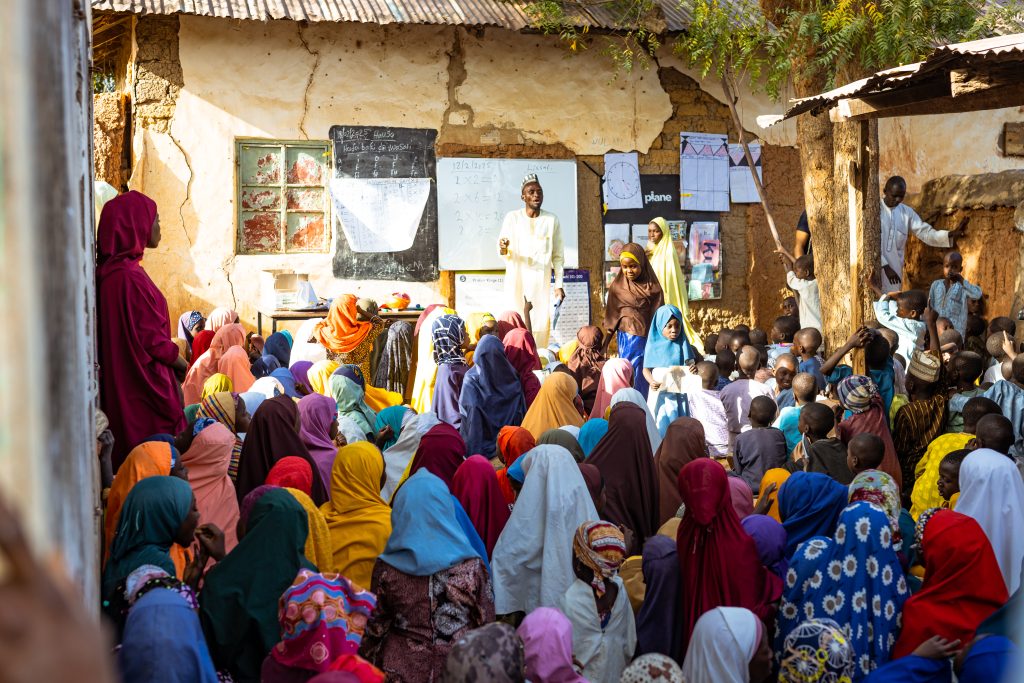
  1. Community mobilisation for learner enrolment.
  2. Enrolment assessments with MEAL & facilitators.
  3. Learners grouped (50 per space, 2 facilitators).
  4. Distribution of teaching & learning materials.
  5. 12-week sessions (90 minutes daily, 5 days/week).
  6. Flexible learning spaces determined by communities.
  7. Formative, midline & endline evaluations.

Key Interventions

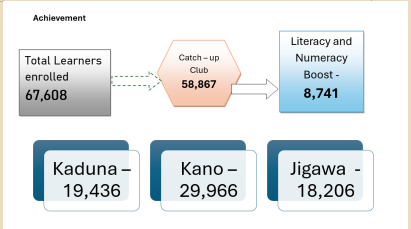
  • Literacy & Numeracy Boost Camps (Ages 6–9)
  • Catch-Up Clubs (Ages 9–13)
  • Home-Based Learning in insecure areas
  • Very Young Adolescent Clubs
  • Social Behaviour Change (CAC Model)
  • Gender-transformative SBCC
  • Support for Children with Disabilities
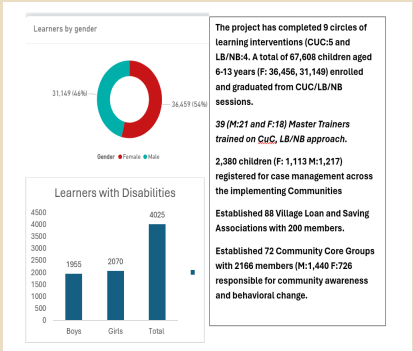
  • Household Economic Strengthening (VSLAs)
  • Community Case Management

Education Focus

The programme addresses literacy and numeracy gaps for children at risk of dropping out or those out-of-school for up to two years through integrated, innovative approaches:

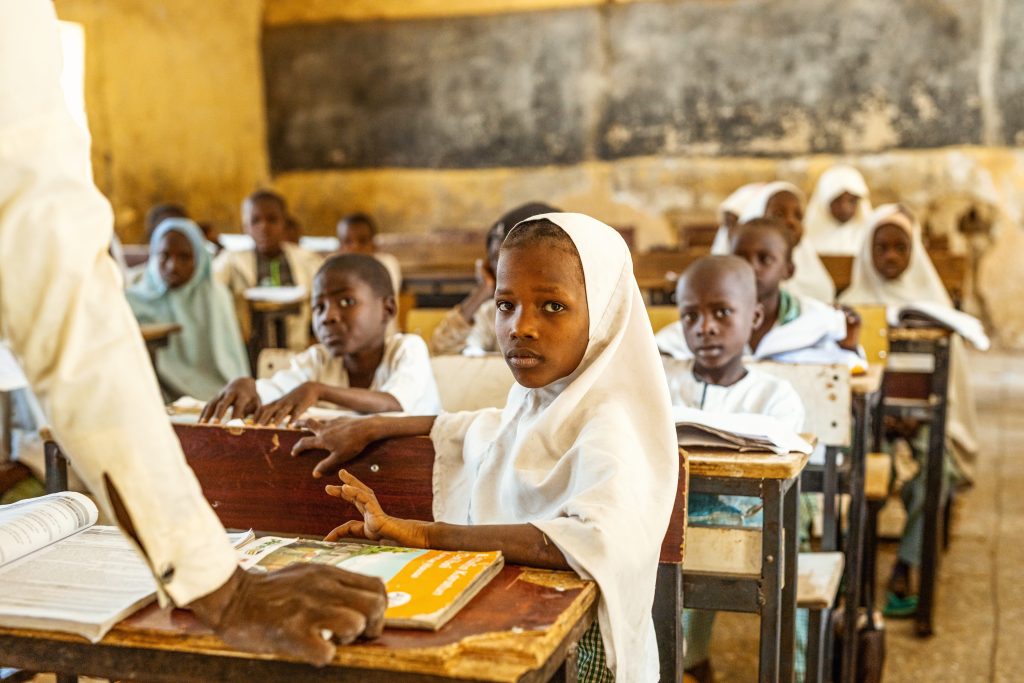
  1. Catch-Up Clubs: Remedial classes for children aged 9–13.
  2. Literacy Boost: Reading improvement for ages 6–8.
  3. Numeracy Boost: Strengthening early mathematics skills.

Key Outcomes

  • Increased completion of community-based learning interventions and improved well-being and life skills among girls, boys, and children with disabilities
  • Strengthened community engagement to create an enabling environment that supports children’s rights and access to inclusive, quality education.
Window 3
Social Behavioural Change Communication (SBCC) SBC Approach:

For a community to be supportive, communities must be actively engaged to support families to enrol their children, enable them to attend school regularly and maximise educational outcomes. One of the ways we achieve this is by developing a comprehensive social and behaviour change (SBC) strategy, using the Socio-ecological Model for Change. The strategy includes a set of complementary interventions that not only raise awareness, but also address determinants, attitudes, practices and existing social, gender and cultural norms and barriers that specifically limit children’s access to quality education, especially disadvantaged girls and children with disabilities. The socio-ecological approach will allow for interventions that will target not just the children, but every stakeholder involved in each child enrolling and completing school. This will include parents/guardians, teachers, community leaders and members, religious and traditional leaders and government stakeholders.

Overarching Community Engagement Approach: (Community Action Cycle)
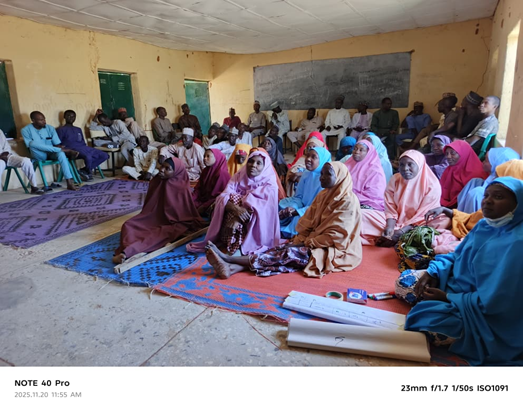
SC’s flagship community engagement approach – Community Action Cycle (CAC)1 is a proven community mobilization/community capacity strengthening approach which fosters individual and collective action to address key program goals and related outcomes. Applied to improve education, protection and wellbeing outcomes, the CAC works to increase social and behavior change and access to and demand for services, especially where gender and other socio-cultural barriers exist.
The CAC approach fosters a community-led process through which those most affected and interested organize, explore, set priorities, plan and act collectively for improved education and wellbeing outcomes. The Core Group members work in turn with their respective wider community group (CAC Group) to implement and monitor actions throughout the CAC. PLANE W3 will establish various interventions in communities for foundational learning, household economic strengthening and child protection. The facilitators of these interventions will be drawn from the community and will: – -Attend CAC meetings and know about actions in the action plan;
  1. Gather feedback on education experience from group participants (with particular focus on children from CuCs, VYA, LB/NB groups)
  2. Where relevant, implement planned actions with their respective groups.
Quality Improvement through Partnership Defined Quality Scorecard:
A quality improvement component will be blended with the Community Action Cycle to address issues of poor-quality education. Through the Partnership Defined Quality Scorecard (PDQS) methodology, we improve the quality and accessibility of education with community involvement in defining, implementing, and monitoring the quality improvement process. PDQS ensures that the quality of service is not only improved through system strengthening efforts that equip schools and train teachers but also by considering community concerns and perspectives and helping to build a mutual understanding of quality and inclusion within education.
The School Based Management Committees and Ward Development Committees will collaborate with CAC Facilitators, Community Core Groups and Very Young Adolescent Clubs (VYA) through the phases of the CAC to: identify education quality issues from the perspective of community members (including school children), and service providers (LGA coordinators, head teachers, teachers, school management board members); agree on quality issues to be addressed; turn issues into indicators; score and monitor indicators on a periodic basis through interface and community feedback meetings. Core Group members will make concerted efforts to collect feedback from girls and boys by engaging members from VYA Clubs, and CuCs (to ensure out of school children are included). 0ther Interventions with Media Partner are include:
    1. Community video and theatre events (positive deviants)
    2. Radio Serial Drama, Interactive Radio Magazine programme, Radio spots,
    3. Road shows and Advocacy visits
Media & Advocacy Interventions
  • Community video and theatre events (Positive Deviance approach)
  • Radio serial drama and interactive radio magazine programmes
  • Radio spots, road shows, and advocacy visits
Role of Save the Children International (SCI)
  • Facilitation & Formation: Community mobilization, beneficiary identification, and VSLA establishment.

  • Capacity Building: Financial literacy, governance, record keeping, and loan management training.

  • Government Linkages: Registration as cooperatives to access loans and government support.
  • Integration with Protection: Leveraging VSLA meetings to promote positive parenting and child protection.

  • Monitoring & Mentorship: Continuous support through trained Village Agents and data tracking.
Household Economic Strengthening (HES / VSLA)
  • Household Economic Strengthening (HES) reduces family economic vulnerability and empowers caregivers to meet the essential needs of children without reliance on external assistance.

  • Village Savings and Loan Associations (VSLAs) promote financial inclusion for women, caregivers, and youth through savings and internal lending cycles of 10–25 members.

  • In Kano State, VSLAs provide a grassroots solution to poverty, limited financial access, and gender-based exclusion—building household resilience and sustainable livelihoods.

Household Economic Strengthening (HES/VSLA)

  • HES comprises a portfolio of interventions to reduce the economic vulnerability of families and empower them to provide for the essential needs of the children they care for, rather than relying on external assistance.
  • HES is most effective when activities are well-matched to the specific needs and capabilities of targeted children and adult caregivers.
  • Village Savings and Loan Associations (VSLAs) are community-based financial platforms aimed at enhancing financial inclusion, particularly for vulnerable and underserved populations such as women, caregivers, and youth, the group consist of 10 – 25 people who save together and take small loans from those savings.
  • VSLA run in ‘cycles’ of about one year, after which their money is shared out in proportion to what they have saved.
  • In Kano State, where many households face poverty, limited access to formal financial services, and gender-based financial exclusion, VSLAs offer a grassroots solution for building household resilience and promoting livelihoods.
  • Enhanced ability of families to afford school materials and health services for children.
  • Increased household income and resilience through savings and internal loans.
  • Improved financial decision-making among women and caregivers.
  • Strengthened community structures for peer support and collective action.
  • Improved social cohesion among community members.
  • The groups were able to pool financial resources as follows for year two. Currently they commenced 3rd cycle as a self-managed
What Makes SCI’s Approach Unique:
  • Integration with Education and Protection:
    By targeting caregivers of out-of-school children, especially those in the Catch–Up Clubs (CuC) program, SCI links economic empowerment to learning outcomes and child protection.
  • Child-Focused Lens:
    SCI’s VSLA interventions are strategically designed to improve child well-being by empowering caregivers, particularly mothers, to meet the health, nutrition, and educational needs of their children.
  • Gender-Sensitive Programming:
    SCI actively promotes women’s leadership and participation in VSLAs, helping to address social and financial gender gaps.
  • Evidence-Based Methodology:
    SCI employs monitoring tools, participatory evaluations, and community feedback mechanisms to refine its VSLA approach and ensure accountability.
Role of Save the Children International (SCI):
Save the Children International implements VSLAs as part of its Livelihoods and Resilience strategies under development and humanitarian programs such as the PLANE (Partnership for Learning for All in Nigerian Education) project. The key roles SCI plays include:
  • Facilitation and Formation: SCI mobilizes communities, identifies beneficiaries (e.g., caregivers of children in Catch Up Club), and trains them to form and manage VSLAs.
  • Capacity Building: SCI provides structured training on group dynamics, financial literacy, savings principles, record keeping, and loan management to ensure effective and transparent VSLA operations.
  • Linkages to government and registration as cooperative: SCI facilitates the registration of the VSLA groups into the government system and were able to acquire cooperate registration in order to have access to loan and other government support.
  • Opportunity for integration and access to services: Child Protection leverage on the VSLA meeting to conduct safe family sessions for the members to cascade to other community members to achieve positive parenting and reduce traditional harmful practices against children.
  • Monitoring and Mentorship: SCI supports groups through trained community-based Village Agent, ensuring sustainability, mentoring, and data tracking.

Child Protection

Community Case management to ensure girls and boys are protected and empowered to pursue their right to an education.
These interventions target girls and boys facing protection risks (family separation, gender-based violence, neglect and abuse)
to have access to responsive integrated case management services and referral to specialized services.
Window 3
Community Case Management

Children with protection concerns attending all community-based learning programmes (CuCs, LB/NB, VYAC and remote learning) will receive case management services to retain and improve learning outcomes as well as build self-confidence.

In addition, children with protection concerns referred by the wider community, either represented within VSLAs, CCs, Core Community groups, etc., will also be provided case management services.

Safe Family Common Approach

Caregivers of children undergoing case management and VSLA members as well as other interested caregivers in the community are enrolled in a Parenting Without Violence (PWV) circle. CSADI, Kishmi, POTHE and HVCF staff are trained on the PWV curriculum and establish PWV circles in each hub school community. These run for three months.
Window 3
Establishing / Updating and Supporting Community-Based Child Protection Committees

Community mapping and stakeholder analysis was carried out to identify community structures. Identified committees are trained on child protection concerns and how to respond to them.

The establishment of CBCPC communities helps to support community-based child protection mechanisms and ensure a more protective environment in the long term.

Expanding Government Social Workforce Capacity

The project has taken steps to strengthen government workforce capacity by promoting government buy-in and strengthening government social workers' capacity for inclusive child protection programs.

They were trained on child protection minimum standards, standardized case management, CPIMS, GBV, Mainstreaming CP in Education, PSEA and the State Child Rights Law. Advocacy messages are developed to support improved budgetary provisions for the Ministry of Women's Affairs and Social Development to hire additional social workers and accommodate community case workers in future budgets.
Window 3
Very Young Adolescent (VYA) Clubs

Very Young Adolescent clubs were established in communities for both girls and boys to provide a safe environment for peer-to-peer learning, awareness-raising and motivational sessions by identified role models and community leaders.

The primary group accessing the clubs are children enrolled in Catch Up Clubs. The VYA club runs for 12 weeks alongside the CuC cycle.

The key resource for spaces is the VYA curriculum which was vetted by key Government stakeholders for children aged 10–14. This has been adapted for the Nigeria context and is available in Hausa.

Social Emotional Learning Foundations

Social Emotional Learning Foundations is SC’s approach to the development of a set of foundational skills, competencies, behaviors, attitudes and personal qualities which enable children and young people to effectively navigate their environment, work well with others, perform well, challenge negative social and gender norms that limit their potential and achieve their goals.

The clubs provide physically accessible, safe and protective spaces for sharing information and discussing gender specific issues such as menstrual hygiene management, gender roles, gender-based violence, sexual reproductive health topics, and the intersectionality with disability.

Gender Equality, Disability Inclusion & Safeguarding
The PLANE Gender Equality and Disability Inclusion (GEDI) Strategy is a cross-cutting approach designed to address the
root causes of harmful gender norms,
discriminatory practices, and the exclusion of children with disabilities from opportunities and their rights.

Gender Equality & Disability Inclusion (GEDI)

  • In the context of Jigawa, Kaduna, and Kano States, the strategy aims to create an enabling environment where all children, especially girls and children with disabilities, can learn, meaningfully participate, and thrive.
  • At the heart of this approach is the understanding that meaningful participation in education works hand in hand with a supportive community that ensures that no child is left behind.

Safeguarding

  • The primary objective of this strategy is to ensure effective safeguarding mainstreaming in the PLANE project W3, protecting all participants, community members, and staff.
  • Rooted in SCI safeguarding policies and procedures, including safe programming and partnership protocols, this strategy applies to all staff, volunteers, partners, and stakeholders within the PLANE programme in Kaduna, Kano, and Jigawa states.
  • The strategy outlines key safeguarding priorities and ways of engaging stakeholders while aligning with project goals and evolving methodologies.
  • It is designed to be adaptive, ensuring safeguarding and protection remain integral to implementation and responsive to emerging needs.

Community-Driven Interventions

The PLANE Gender Equality and Disability Inclusion (GEDI) Strategy is a cross-cutting approach designed to address the root causes of harmful gender norms, discriminatory practices, and the exclusion of children with disabilities from opportunities and their rights. In the context of Jigawa, Kaduna, and Kano States, the strategy aims to create an enabling environment where all children, especially girls and children with disabilities, can learn, meaningfully participate, and thrive.
At the heart of this approach is the understanding that meaningful participation in education works hand in hand with a supportive community that ensures that no child is left behind To promote gender-transformative and disability-inclusive change, PLANE implements a set of practical, community-driven interventions that work at household, school, and system levels. These include:
  1. Awareness Raising & Community Sensitization:The GEDI team works with communities, caregivers, and children to increase understanding of the unique needs of girls and children with disabilities, encouraging inclusive attitudes and challenging harmful beliefs.
  2. Collaboration with OPDs:The GEDI team collaborates with Organizations of Persons with Disabilities (OPDs) to ensure interventions are informed by lived experiences and address real barriers.
  3. GEDI Assessments:Assessments conducted at community and LGA levels identify deeply rooted discriminatory norms, informing implementation, monitoring, and evaluation.
  4. Capacity Building for Facilitators:Facilitators are trained in creative, inclusive teaching methods and equipped to provide tailored support to children with disabilities.
  5. Identification & Enrolment:Children with disabilities are identified and enrolled into Catch-Up Clubs, Literacy & Numeracy Boost, and VYA sessions.
  6. Inclusive Learning Materials:Inclusive learning materials are provided to improve comprehension, participation, and learning outcomes.
  7. Medical Assessment & Assistive Devices:Children are referred for medical assessments and provided assistive devices such as hearing aids, glasses, and mobility aids.
  8. Mainstreaming into Formal Education:Graduated learners are supported through community-led initiatives to transition into formal schools for continued education.

Monitoring, Evaluation, Accountability & Learning (MEAL)


    The PLANE MEAL unit strategically contributes to project design, implementation, and learning by providing evidence that supports decisions and promotes accountability among learners and communities.
  • Leading Learner Enrolment:Identification and verification to ensure the right learners are targeted.
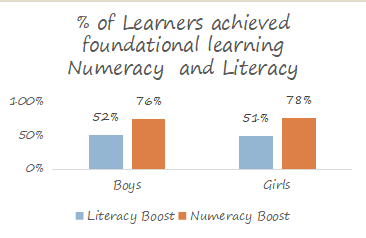
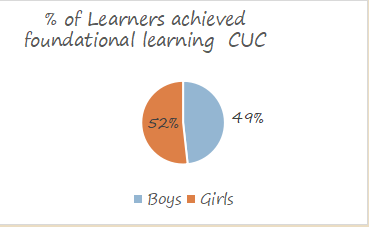
  • Learning Assessments:Baseline and endline assessments measure literacy and numeracy impact.
  • Accountability Mechanisms:Feedback systems including suggestion boxes, consultations, and stakeholder training to strengthen trust and responsiveness.
  • Indicator Performance Tracking:Tracking logframe indicators to measure progress and document learning.
  • Quality Benchmark & Data Quality Assessment:Ensuring activities align with project goals and meet established standards.
Top